12V DC Solar Water Pump vs Deep Well Pumps (Off-Grid)
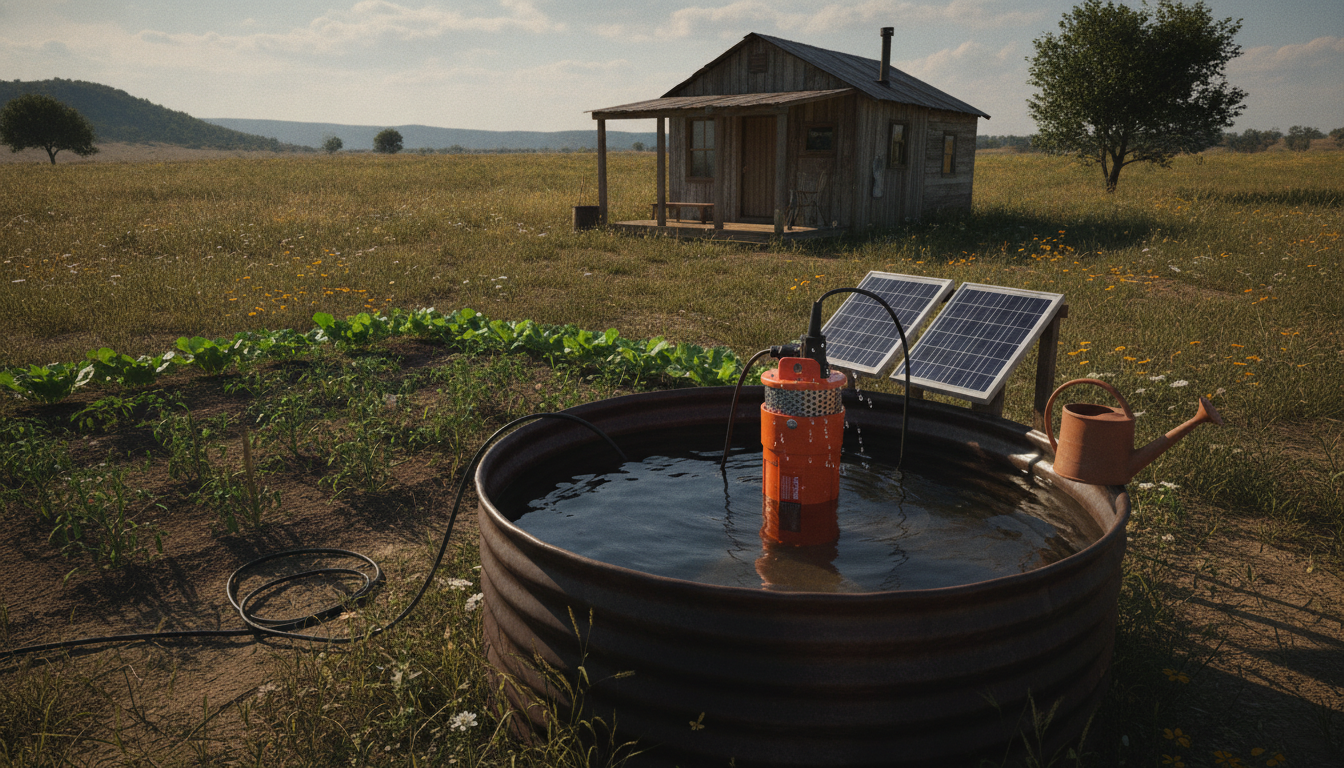
Solar Water Pump 12V DC vs Deep Well Submersible Pumps for Off-Grid Irrigation
Off-grid watering works best when the pump, power source, and water demand match. A 12V DC solar-ready submersible pump can simplify irrigation for gardens, small plots, livestock troughs, and remote cabins—especially where utility power is unavailable or expensive. This guide compares solar-capable 12V DC options with other deep well submersible approaches, focusing on lift, flow, wiring, runtime, and real-world setup choices. For more guidance, see [PDF] Guide to Solar-Powered Water Pumping Systems in New York State.
When a 12V DC solar submersible pump makes sense
A 12V DC submersible pump is often the most straightforward starting point for basic off-grid irrigation because it stays in low-voltage DC and can pair well with common solar-and-battery setups. For further reading, see Solar-powered Groundwater Pumping Systems | CSU Extension.
- Remote irrigation where solar/battery power already exists: Great for cabins, sheds, and pastures that already run 12V lighting, radios, or small appliances.
- Intermittent pumping: Ideal for filling a storage tank, topping off a trough, or running short watering cycles rather than nonstop high-volume pumping.
- Simpler power chain than AC pumps: Avoids inverter sizing, inverter losses, and many AC-startup headaches when you can stay DC end-to-end.
- Best for small-to-medium flow needs: Works well for drip zones, hoses, or tank transfer rather than large field irrigation that demands sustained high flow.
Key performance terms that decide success
Most off-grid pump disappointments come from a mismatch between head (lift), flow, and system losses. A few core terms help you size the system correctly.
- Total dynamic head (TDH): Vertical lift plus friction loss from pipe length, fittings, filters, and valves.
- Flow rate: The gallons (or liters) per minute you need at your required head, not just at “zero lift.”
- Duty cycle: Whether the pump is designed for continuous operation or short bursts.
- Water conditions: Clean well water vs sand/silt; intake screens and filtration can protect the pump and reduce clogging.
- Well dimensions: Casing diameter and depth determine what physically fits and where the pump can be set.
Quick comparison for off-grid irrigation setups
| Option | Power requirement | Typical strengths | Common trade-offs | Best use case |
|---|---|---|---|---|
| 12V DC solar-ready submersible | Solar + controller and/or battery (12V) | Low-voltage operation; simpler off-grid wiring; easy to pair with small solar arrays | Limited output vs larger AC systems; careful sizing needed for high head/long pipe runs | Remote gardens, trough fill, small tank transfer |
| 24–48V DC submersible (solar) | Larger solar array and higher-voltage controller | More efficient at higher head/flow than 12V in many builds | More components and higher upfront cost | Bigger off-grid irrigation with longer runs |
| AC deep well submersible + inverter/generator | Inverter from batteries or generator/utility | Wide pump selection; strong performance options | Inverter losses; generator fuel/maintenance; more complex system | High-demand irrigation or existing AC infrastructure |
| Surface pump (DC or AC) near source | Depends on motor type | Easy access for maintenance; good for shallow sources | Cannot lift from deep wells; priming and suction limits | Ponds, shallow wells, storage tanks |
For deeper detail on solar pumping basics, the U.S. Department of Energy’s solar water pump overview is a helpful reference. For estimating friction loss in pipes, see the Engineering Toolbox Hazen-Williams resources.
Power planning: panels, batteries, and controllers
Your power setup determines whether a pump feels “strong” at the outlet—or struggles and surges all day.
- Solar-direct vs battery-backed: Solar-direct pumping is usually simplest and favors daytime filling of a tank. Battery-backed pumping adds flexibility for evening or early-morning watering and can stabilize voltage for more consistent flow.
- Controller basics: A controller with overcurrent protection and low-voltage cutoff helps protect both pump and battery, especially when clouds or long wire runs cause voltage sag.
- Voltage drop matters on 12V: At 12V, current is higher for the same wattage. Longer cable runs need thicker wire to reduce voltage drop, which otherwise lowers pump speed and flow.
- Water storage strategy: Pumping into a storage tank (especially elevated) can reduce how often the pump must run and can make drip irrigation steadier with a gravity feed or pressure regulator.
Installation notes for deep well submersibles
A solid installation does more than prevent leaks—it improves reliability and makes future maintenance less painful.
What to expect from a budget-friendly off-grid pump
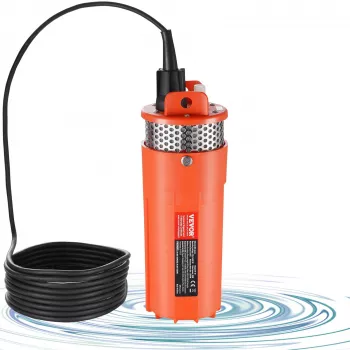
Product option: Solar Water Pump 12V DC – Deep Well Submersible Pump for Irrigation & Off-Grid Use
If the goal is a practical, low-voltage solution for remote watering, Solar Water Pump 12V DC – Deep Well Submersible Pump for Irrigation & Off-Grid Use is a budget-friendly entry point for tank filling, trough top-offs, and small irrigation schedules—when sized to your lift and plumbing run.
Other in-stock items
FAQ
Can a 12V DC submersible pump run directly from a solar panel?
Yes, in many setups it can, but flow will rise and fall with sunlight. A controller and/or battery helps stabilize voltage, improves startup reliability, and reduces the risk of stalling during passing clouds.
How is deep a “deep well” for a small solar submersible pump?
“Deep” depends less on the well’s total depth and more on total dynamic head (water level, discharge height, and friction loss). Measure your pumping level and plumbing run, then choose a pump rated to deliver your needed flow at that head.
What causes low flow in an off-grid well pumping system?
Low flow commonly comes from excessive head, undersized wiring causing voltage drop, narrow or long piping, clogged intake screens or filters, air leaks at fittings, or insufficient solar power during weak sun.








Leave a comment